Nine devices on one truck.One system that reads them all.
Hardware on its own gives you readings. What you want is an answer — who drove, how many litres actually went in, whether the cap was opened at two in the morning. This page walks through every device we fit, what it measures, and how the platform turns those readings into something you can act on.
- Fitted devices
- 9 Fitted devices
- Platform
- 1 Platform
- Check cycle
- 5 min Check cycle
Everything we fit
Fitted, calibrated and commissioned by our own engineers, then read by one platform — so the devices argue with each other rather than with you.
GPS & telematics unit
Live position, route replay, geofences and driver behaviour — buffered through dead zones so nothing is lost.
Fuel level probe
Calibrated to your tank’s real shape and temperature-corrected, so litres are litres rather than a percentage off a gauge.
Smart fuel cap
Cap openings and tampering reported live, read together with the tank level to tell a refuel from a siphon.
Anti-siphon device
A passive one-way barrier in the filler neck. Fuel goes in; a hose does not come back out.
In-cab driver screen
Jobs, proof of delivery, inspections and fuel requests captured in the cab and filed against the job instantly.
iButton driver ID
Driver, vehicle and trip bound at touch-in — so behaviour and fuel are scored per person, not per plate.
Breathalyser interlock
A pre-start test wired into the starter circuit. A fail keeps the ignition locked and notifies the office.
CAN bus interface
The engine’s own metered fuel, true odometer, engine hours and fault codes — a second independent source.
Asset tracker
Battery-powered tags for trailers, containers and gensets. No wiring, years per battery, same map as the trucks.
The camera is not a dashcam you review after a crash.
An in-cab camera earns its place by what it catches before anything happens. Ours reports the event as it occurs, over the same link as the GPS, and the footage is pulled off the card automatically when it matters — because the SD card is a loop, and a clip nobody fetched is a clip that gets overwritten.
What the road camera reports
Forward collision warning, lane departure, following too close, pedestrian ahead and traffic-sign recognition — each arriving as an event with its own severity, not a video file for somebody to watch later.
What the cabin camera reports
Fatigue, phone use, smoking, distraction and seatbelt. Also lens covered or infrared blocked — treated as critical, because a camera someone has taped over is telling you something.
Who was actually driving
Face recognition or iButton opens a duty session and assigns the vehicle to that driver. Every event, and every fuel movement, attaches to the person who was in the seat rather than to whoever the truck is registered against today.
See the cab now
Live video streams to the browser on request — no app, no proprietary viewer. Opened from the vehicle on the map, when a dispatcher needs to know what is happening rather than what happened.
Footage pulled before it is lost
A critical event fetches its own clip off the vehicle automatically. Ask for any other window by date and time and it is retrieved on request — while it is still on the card.
Kept as long as it is needed
Routine footage is held 90 days, footage attached to a serious event for three years, and anything under legal hold indefinitely. Stored privately and encrypted; every view and download is recorded.
The cabin is gated separately
A driver-facing camera watches a person at work, so it sits behind its own permission and a recorded consent acknowledgement. Road-facing footage does not carry that weight and is not treated as though it does.
One note on what an alert is worth. A safety system that fires constantly gets switched off, so ours are held to the same standard as the fuel alerts on this page: a warning has to survive the vehicle’s own normal behaviour before anyone sees it. On one truck, a speed-sensor rule that would have raised 696 alerts in a month raised none once it had learned that vehicle’s own calibration offset — while a genuine sensor failure still clears the bar.
A fuel sensor does not measure litres. Here is what actually happens.
This is the part most suppliers skip, and it is the part that decides whether you trust the alert at 3 a.m. A probe returns an electrical count. Four things have to happen before that count is a litre you would put on an invoice.
The probe returns a count, not a volume
A capacitive probe outputs a number that rises and falls with the fuel around it. On its own it means nothing — it has to be mapped to your specific tank.
raw = 843The tank’s real shape turns count into litres
Tanks are not boxes. A horizontal cylinder holds far less per centimetre near the top and bottom than in the middle, so a straight-line conversion is wrong at both ends. We build the curve from the tank’s actual shape and anchor it to real pump receipts.
843 → 108.8 LHeat moves the reading, and GCC heat moves it a lot
Two separate effects: diesel expands as it warms, and the probe itself drifts with temperature — on our fleet the probe’s own drift measured about three and a half times larger than the fuel’s expansion. Left uncorrected, a parked truck appears to gain several litres overnight and lose them by afternoon.
−0.32 L per °C, removedWhat went in, what was burned, what is left
Start level, plus every fill, minus expected consumption, should equal the end level. Anything left over is unexplained — and that, not a single dip in a graph, is what raises an alert.
start + fills − burn − end = unaccountedWhy a dip is not a theft
Fuel sloshes when a truck moves, and a probe reads the slosh. A real loss sticks — the level stays down afterwards. A dip that recovers was never fuel leaving the tank.
Why we watch parked trucks hardest
With the engine off, expected consumption is zero. Any sustained drop under those conditions has no innocent explanation, which makes it the cleanest signal there is.
Why idling matters more than economy
821 L · 367 h idle · 2.23 L/h
A truck idling burns fuel that moves it nowhere, and km/L punishes it twice. We report idle hours and idle litres separately, so a low economy figure can be explained rather than argued about.
The engine keeps its own accounts. We read those too.
Every modern truck runs an internal network — the CAN bus — that the engine, gearbox and instrument cluster use to talk to each other. Tapping it gives a second, independent measurement of the same truck. Where two sources agree you can act with confidence. Where they disagree, you have a question worth asking.
Fuel the engine says it burned
The ECU counts injector pulses. That figure cannot be moved by slosh, heat or a tilted parking spot — the three things that make a tank probe argue with itself.
Tank versus engine
The tank is the only thing that sees fuel leave without being burned. The engine is the only thing that knows what it burned. Subtract one from the other and what remains is unaccounted fuel — the number that actually matters.
True odometer and engine hours
Real readings rather than GPS estimates, so service intervals, cost per kilometre and driver comparisons all rest on the same number the workshop reads off the dash.
Fault codes before the breakdown
Engine warnings, service-distance countdowns and malfunction indicators surface in the platform while the truck is still running, not when it stops at the roadside.
No CAN cable? Nothing breaks. Older trucks and mixed fleets still report distance from GPS and fuel from the tank probe. CAN sharpens the picture where it is available; the system never depends on it.
Nine data streams. One version of events.
Any supplier can sell you a box that reports a number. The hard part is what happens next — reconciling a tank reading against a receipt, a cap opening against a fill, a driver tag against a trip. That reconciliation is the product.
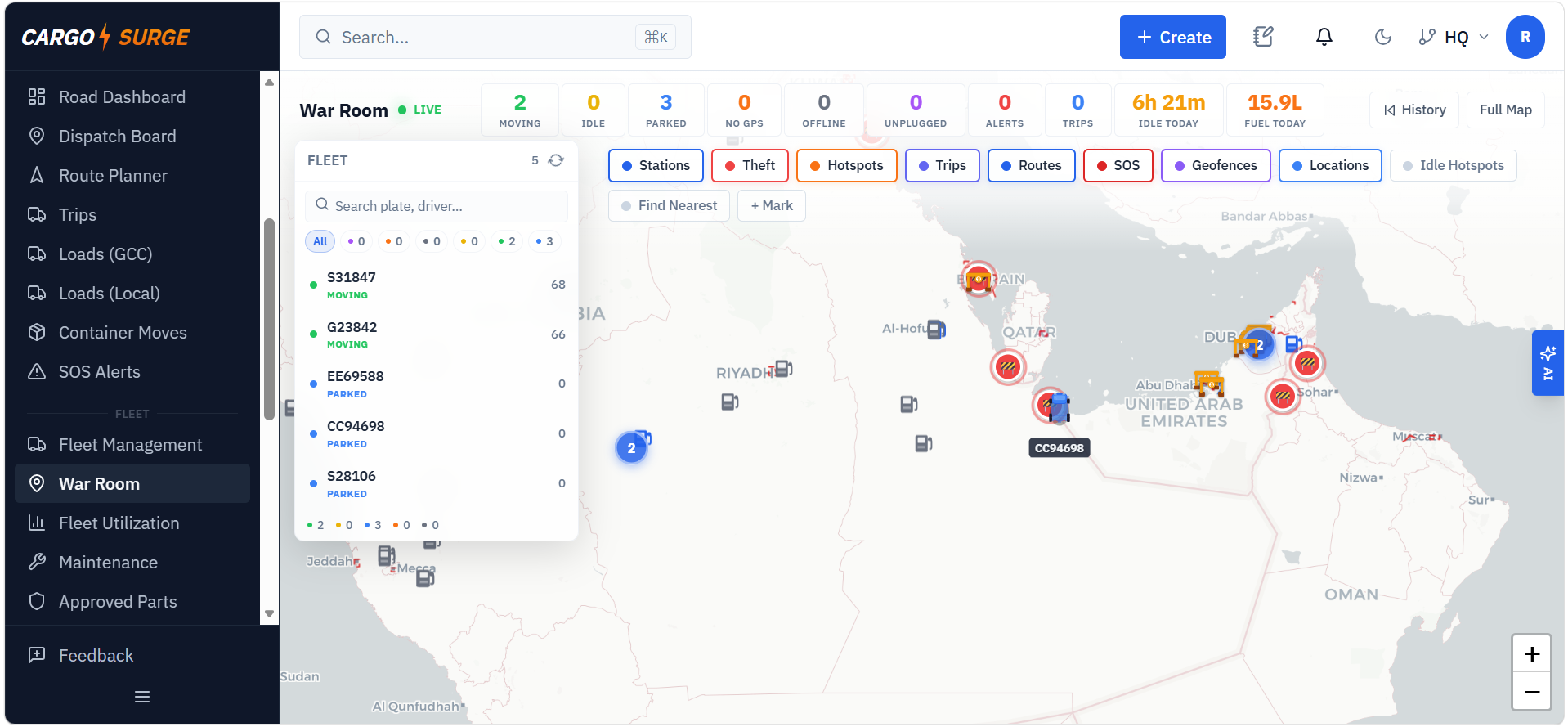
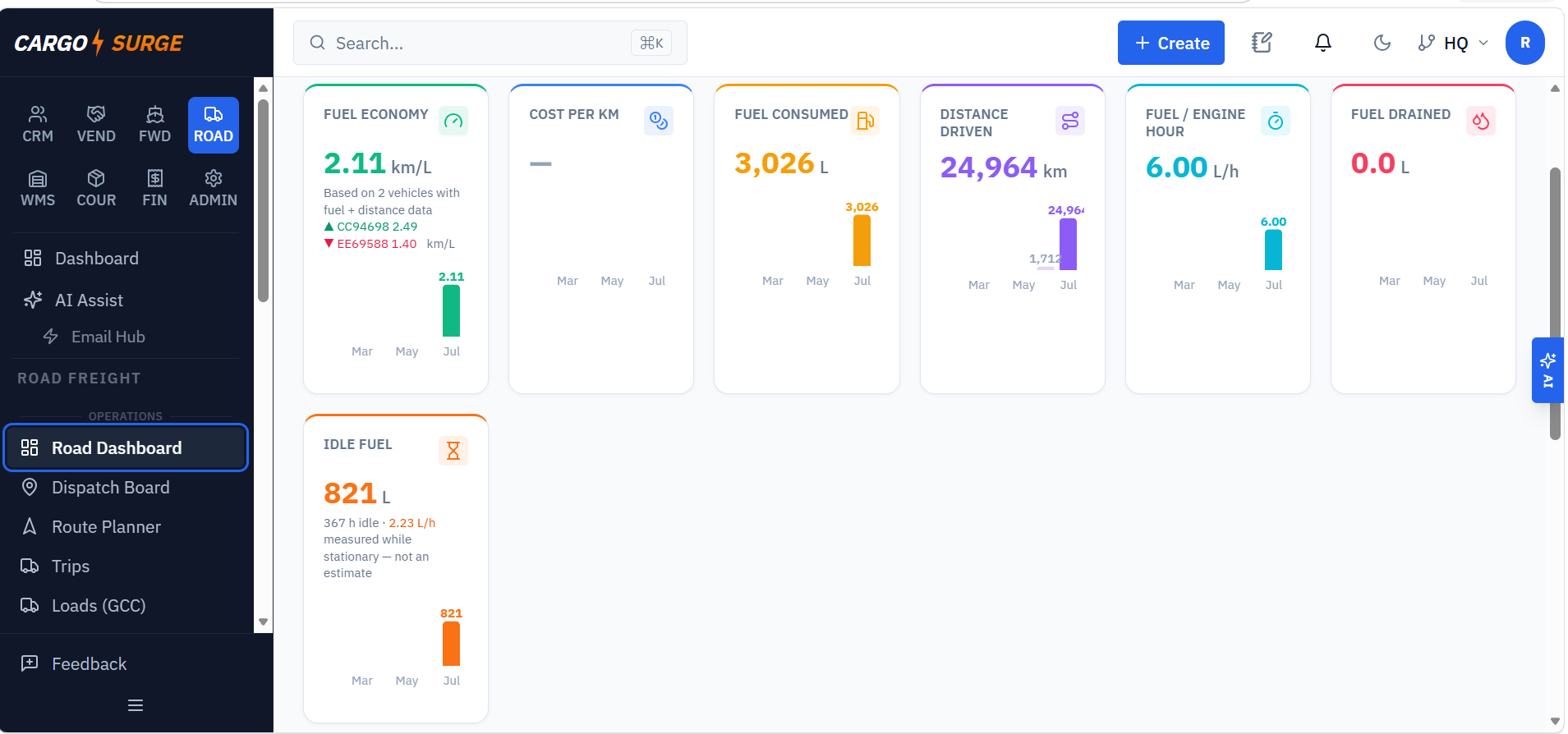
A reading you can act on, or it is not worth fitting.
Fuel telemetry has a credibility problem: sensors drift, heat moves the reading, and a false theft alert costs more trust than the fuel was worth. We engineer against that specifically.
Tank-shape
Calibrated to your vehicle
The curve is built from the tank’s own geometry and anchored to real pump receipts — not a percentage stretched across a gauge.
73%
Thermal drift removed
We measure each probe’s own temperature response from readings taken while parked, where the volume cannot change, and correct it out.
5 min
Round-the-clock watch
Every truck re-checked continuously — parked, idling or moving. Theft does not wait for office hours.
Persist
Alerts you do not learn to ignore
A loss must hold, and outlast the sensor’s own noise, before anyone is told. An alarm nobody trusts is worse than none.
Fit one truck. Compare it against the rest of the yard.
We will fit a single vehicle with the full kit, run it for a month, and put the numbers beside a truck you have not touched. If it does not pay for itself, that is the answer.